

235,715
Delivered orders

Searching someone who can help with assignment help online? Hire our best assignment experts and enjoy the best grade.

ocial behaviour is really considered in isolation. Rather, our society assigns meaning labels and identities that transform
rogramming assignments are the tasks and projects which are assigned to the students. These assignments focus on the
S
ocial behaviour is really considered
how actions are perceived and treated. This idea lies at the heart of labelling theory, a sociological perspective that shows how labels shape individual identity and behaviour. Instead of focusing on the act itself, this theory highlights how society’s reaction creates deviance.
in isolation. Rather, our society assigns meaning labels and identities that transform how actions are perceived and treated. This idea lies at the heart of labelling theory, a sociological perspective that shows how labels shape individual identity and behaviour. Instead of focusing on the act itself, this theory highlights how society’s reaction creates deviance.
If you want to know more about this theory and its application, then this is the right place for you. This blog is all about finding the answer to what is labelling theory? Let us explore its historical roots and the major thinkers behind it. This theory is related to fields of sociology, psychology, and criminology, and you learn the key concepts of it with real-world examples.

The theory of labelling refers to a sociological framework that claims deviance is not inherent in an act, but is created through social interchanges. Behaviour becomes deviant only when society labels it. And once the label is applied, it can strongly impact how you see yourself and how others behave with you.
The theory implies that individuals often internalise labels set on them, which can lead to behavioural changes. For example, if you are constantly called a “troublemaker” by the people in your surroundings, then you may engage in actions that reinforce this identity.
So, when you ask, "What is labelling theory?" The simple answer would be the act of society labelling you with a particular term that you are not, yet you end up defining that term. The focus here is not on the rule-breaking but on societal response.
The theory of labelling appeared in the 1960s, rooted in the symbolism of interactionism. Around this time, sociologists aimed to understand how meanings are created through everyday interactions rather than fixed rules.
Howard Becker's work “Outsiders” in the year of 1963 has played a vital role in standardising this theory. Bekar argued that social groups form deviance by making rules and using them selectively. This diverted attention away from individual wrongdoing and toward power, authority, and social control.
The theory of labelling shows how the concept extends beyond one particular discipline.
Sociology: This theory explains social inequality and marginalisation.
Psychology: It examines the levels that affect self-concept and mental health.
Criminology: It applies to understanding crime, punishment, and recidivism.
The labelling theory of sociology, psychology & criminology is about focusing on identity formation and the long-term effects of health by authoritative institutions such as schools, courts, or the healthcare system. Overall, it is a versatile theory that can be used in multiple disciplines to understand human behaviour.
From the start, deviance is seen as a quality of a certain act. However, the labelling theory of deviance implies that deviance has occurred when society claims and reacts to behaviour negatively. There might be times when two individuals have done the same act, yet only one of them will be labelled based on their social status and background.
This approach shows how power dynamics impact those who have been labelled. As a result, most of the marginalised individuals go through negative comments, reinforced inequality, and social exclusion.
Many of the sociologists have contributed to the development of the labelling theory of sociology, psychology & criminology.
Howard Becker: Presented the idea that deviance is socially constructed.
Edwin Lemert: Introduced the concept of primary and secondary deviance.
Erving Goffman: Discussed stigma and identity management.
Their teamwork justifies how labels grow from simple reactions into lasting social identities.
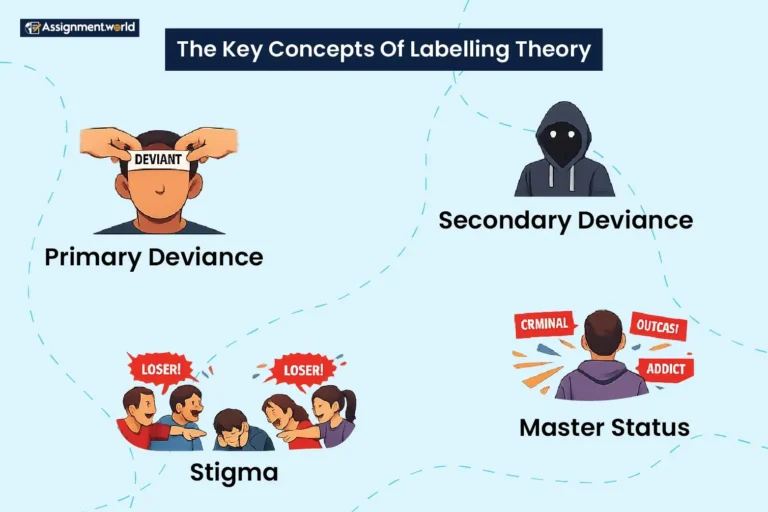
The key concepts of this theory help you to understand how the theory works in real-life situations. These ideas define the process through which labels shape behaviour and identity. Here are the labelling theory key concepts that you need to know about.
Primary Deviance: It refers to nominal rule-breaking that does not concern oneself or one's identity. This behaviour may be unnoticeable sometimes or somehow socially tolerated.
Secondary Deviance: This labelling theory's key concepts happen when you accept a deviant label and start to act according to it. You might not notice, but this label slowly became part of your identity.
Stigma: Stigma affects the social dislike attached to the label. It often leads to exclusion, discrimination, and reduced opportunities for yourself.
Master Status: The master status is a label that overwhelms all the other elements of identity. For example, being known as an “offender”.
The elements of the theory define how the labelling process unfolds within society. These elements work together to shape individual experiences. Below here are all the labelling theory elements:
Social Reaction: This element is the response of society that defines whether behaviour is labelled as deviant. However, according to the labelling theory, without reaction, deviance does not exist.
Power and Authority: Societies such as schools, media, and the legal system uphold the power to assign labels that carry lasting effects.
Self-Identity: This is one of the labelling theory elements that impacts how you perceive yourself, transforming your future behaviours and choices.
Social Exclusion: Once you are labelled, your access to education, employment, and social acceptance is often limited.
Strengths: One major strength of this theory is its focus on power and inequality. The theory describes why some groups face more brutal judgment compared to others. The labelling theory of sociology, psychology & criminology also highlights the unintentional effects of punishment and social control. Additionally, this theory fosters empathy by diverting attention from blaming social contexts to making it valuable for policy analysis and reform.
Limitations: Despite having so many strengths, this theory has limitations. It is claimed that it downplays the seriousness of harmful actions and ignores individual responsibility. On the other side, many point out that it fails to explain why individuals commit primary deviance in the first place.
In summary, none of the researchers dismisses this theory’s value but instead mentions the need to combine it with other viewpoints.
This theory is widely applied in everyday contexts across the fields. For example, in education, academically average students are labelled as “low achievers”, which may internally reduce expectations. In the criminal justice scenario, many struggle to reintegrate due to permanent chemical labels.
On the other side, in mental health, getting a diagnosis can lead to stigma despite clinical intent. Understanding this theory will help you to acknowledge how societal responses affect results more than actions.
As you can see, the theory of labelling has a lot of elements to work with. When you are asked to apply this theory in your academic paper, you are expected to structure the theory perfectly as per the given scenario. Afterwards, you will critically analyse it and evaluate the results. This is too much work for you, where you might not be an expert; however, a professional assignment writer is.
Our professionals at Assignment World are geniuses at applying different theories and frameworks to specific scenarios. You can contact us anytime if you want high grades. With our assignment services, you can seamlessly apply any theory in your desired assignment paper with practical, real-life examples.
Understanding the labelling theory of deviance can help you see how identities are significantly transformed not only by actions but also by societal reactions. Labels are an influence that transforms self-perception and opportunities as well.
Do you need someone who can apply this theory effortlessly in your academic paper? Or perhaps you are in search of science assignment help? Whatever your concern is, Assignment World is always here for you with our premium services. Call us now to grab exciting offers and discounts!