
235,715
Delivered orders

Learn how to write a hypothesis through only 7 easy steps, with different types and tips to strengthen your academic research with confidence.

riting a strong hypothesis is one of the most significant parts of your academic research life, yet it can also
rogramming assignments are the tasks and projects which are assigned to the students. These assignments focus on the
W
riting a strong hypothesis is one
become very confusing for many of you. If you are working on a research paper, dissertation, or project, you must understand how to write a hypothesis clearly and correctly. A well-structured hypothesis gives your study direction, purpose, and focus while showing your analytical thinking.
of the most significant parts of your academic research life, yet it can also become very confusing for many of you. If you are working on a research paper, dissertation, or project, you must understand how to write a hypothesis clearly and correctly. A well-structured hypothesis gives your study direction, purpose, and focus while showing your analytical thinking.
Through this blog, we are going to have a complete overview of the hypothesis. Starting from what it is, its significance, and the key 7 steps to write it. This is a complete hypothesis writing guide that is going to cover everything from top to bottom. With us, you are going to know what to include and what to avoid in your hypothesis writing.

A hypothesis is a clear, testable statement that foresees the relationship between two or more variables. It is not just a random guess but logical assumptions that are based on existing knowledge, observations, or preliminary research. When you are writing a hypothesis, you are stating exactly what you expect to examine in your research.
Unlike a research question, which asks something, a hypothesis can answer it in advance. Your role is to test whether that answer is supported or rejected through data collection and analysis. Understanding the difference is important before moving to hypothesis construction.
A hypothesis often acts as the backbone of your research. Without this, your research can lack direction and clarity. When you frame it correctly, you can create a roadmap that can navigate your methodology, data collection, and analysis.
Following the correct hypothesis writing guide lets you stay focused on your research. Rather than going through unrelated ideas, you can focus only on variables that are relevant to your research. Additionally, your professor often assesses your critical thinking skills throughout your hypothesis. Overall, a hypothesis is a key component of your academic grading.
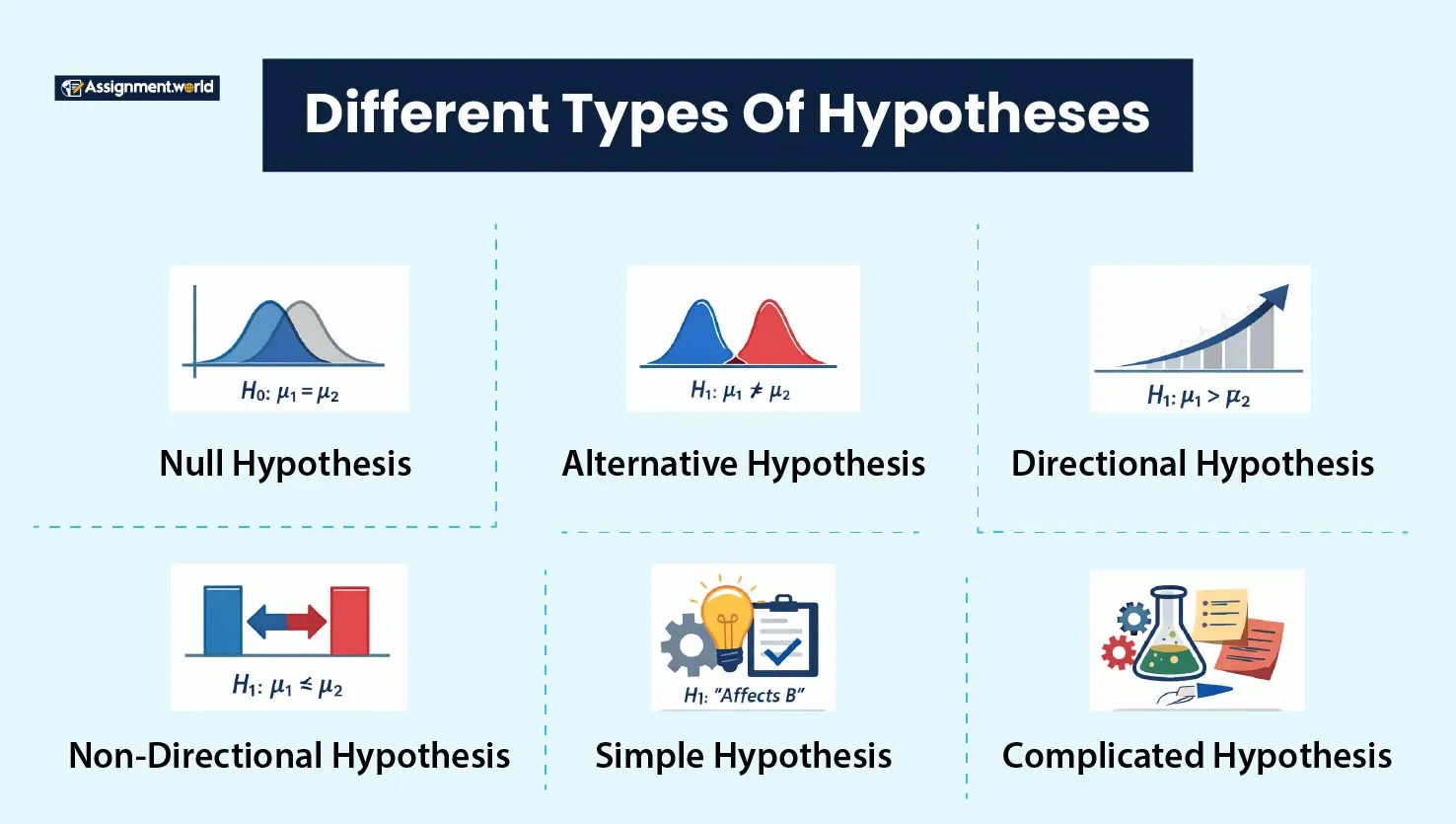
Before you get to know how you can write a hypothesis, you need to understand the different types of hypotheses. Selecting the correct type of hypothesis ensures that your research remains aligned with the objectives.
Null Hypothesis: A type of hypothesis stating that there is no relationship or effect between variables. It is usually written to be tested statistically.
Alternative Hypothesis: This suggests that a relationship or effect does exist between variables and is often what you aim to prove.
Directional Hypothesis: This forecasts the direction of the relationship, such as whether one variable increases or decreases the other.
Non-Directional Hypothesis: This is one of the types of hypotheses to state that a relationship exists, however, not particularly its direction.
Simple Hypothesis: It involves one independent and one dependent variable.
Complicated Hypothesis: It includes multiple independent or dependent variables.
Differentiating between all these categories of hypotheses is going to let you choose how particular or broad your hypothesis should be.
Since you have an overview of the different types, we can now move on to the 7 easy steps to help you write a hypothesis for your research.
Step 1 - Decode Your Research Problem
Before writing a hypothesis, you must clearly understand what problem your study is addressing. Read your topic carefully and find out the research gap, issue, and questions it focuses on. Having a vague understanding can lead to weak hypotheses; hence, take your time to define your research aim.
Ask yourself questions like:
What should I discover?
What do I need to describe?
What should I predict?
Once you have cleared the problem, forming a hypothesis can become easier.
Step 2 - Conduct Preliminary Research
Strong research is one of the significant steps to write a hypothesis. You should never attempt to write a hypothesis without having clear background research. For your research:
Review existing studies on your research topic.
Include peer-reviewed journals and articles from the last 5 years.
Theories that are relevant to your research area.
With these research bases, you can develop logical and informed assumptions. This step makes sure your hypothesis is grounded in academic knowledge rather than personal opinion.
At this stage, you may start noticing patterns, relationships, or contradictions in previous research that inspire your hypothesis.
Step 3 - Identify Key Variables
A hypothesis revolves around variables. Identifying independent and dependent variables is necessary in hypothesis writing steps. The independent variable is what you change or control, whereas the dependent variable is what you measure.
Being precise here lets you ignore confusion later in your research. Clearly, navigating the variables would make sure that your hypothesis is measurable and testable. After all, it is a fundamental requirement in academic writing.
Step 4 - State The Expected Relationship
Once the variables are clarified, define how they relate to each other. Are you predicting an increase, a decrease, or a difference? As this part is about analytical thinking, you may struggle a bit. In this case, contacting an assignment expert from Assignment World can be a wise choice.
Professionals would be able to explain all the parts clearly. The more specific the relationship is, the stronger your hypothesis will be.
Step 5 - Ensure The Hypothesis Is Testable
A hypothesis must be testable using data and research methods. This is another crucial part of the hypothesis writing steps. If it can not be measured or observed, then it does not qualify as a hypothesis.
Consider whether you can realistically collect the evidence to support it or reject it. When the answer is "No", you need to revise the statement until it becomes measurable and practical.
Step 6 - Write A Clear And Concise Statement
Clarity is the real key when you are learning how to write a hypothesis. Your statement needs to be short, direct, and free from any unnecessary jargon. Ideally, it should be written in one sentence that clearly represents the predicted relationship. Avoid combining multiple ideas into one hypothesis, as this can weaken its focus and effectiveness.
Step 7 - Review And Refine
The final step is revision. You need to recheck your hypothesis and make sure that it aligns with your research objectives. If you are short on time, then look for a professional assignment writer to do it. With professional review and correction, you can achieve a polished paper where your hypothesis is compelling, and your research paper meets the academic standards.
While you are learning to write a hypothesis, you must also pay attention to mistakes that can weaken your research papers.
Avoid confusing the predictions with the hypothesis. You need to base your hypothesis on the theories and evidence.
Do not add any vague or immeasurable variables. You need to use validated scales or clearly defined metrics.
Ignore the use of future tense or modal verbs. Your hypothesis needs to be stated in the present tense.
Exclude personal opinion or vague judgments. It needs to be objective and implies moral evaluation.
Knowing these common mistakes makes the process of how to write a hypothesis easy. With these, you can avoid making these mistakes in the future and craft a polished hypothesis.
We present you with some additional tips that you can apply to achieve better results in crafting your hypothesis.
Write clearly and concisely. Even a single sentence can be enough.
Specify the population and context. For example, "among 1st semester students".
Link to theory or prior findings to justify the prediction.
Pre-register your hypothesis for transparency in confirmatory research.
Learning how to write a hypothesis is a skill that enhances with practice and understanding. When you follow a structured approach, define the variables clearly and keep your statements testable, your research can become more focused and credible. A strong hypothesis can navigate your study's analytical skills.
If you need professional assistance in crafting your hypothesis, then we are the ultimate solution for you. In Assignment World, you would get the best assignment help for your hypothesis research. With us, you can conquer your complicated research paper with confidence!