

235,715
Delivered orders

Searching someone who can help with assignment help online? Hire our best assignment experts and enjoy the best grade.

ooking for a more detailed explanation of thematic analysis before you incorporate it in your research? Then, you are at
rogramming assignments are the tasks and projects which are assigned to the students. These assignments focus on the
L
ooking for a more detailed explanation
the right place. This blog will address your specific question, “What is thematic analysis?” in the most comprehensive manner, so you can better grasp the concept and apply it accordingly to derive the ultimate results from your data.
of thematic analysis before you incorporate it in your research? Then, you are at the right place. This blog will address your specific question, “What is thematic analysis?” in the most comprehensive manner, so you can better grasp the concept and apply it accordingly to derive the ultimate results from your data.
So, waste no more time and let’s dive into the crucial facts and aspects associated with thematic data analysis and develop your research paper in the best way possible. Read on to know more.

Thematic analysis is the proper method for dealing with qualitative data in a more systematic manner. What this suggests is that you need to go through a large amount of data or datasets and analyse them to identify patterns in the meaning. It is a process of conducting qualitative examinations to gain valuable insights from the data. However, if this concept is not clear to you on thematic analysis, then you can write your analysis in a research paper with the help of assignment services.
Talking about the benefits of thematic analysis, it is important for you to know that thematic analysis makes the whole process of qualitative examination of data much easier for researchers. With its help, you are able to derive new concepts from your data that is under investigation. It is a flexible approach that is suitable for novice researchers like you when you are proceeding to analyse your data to produce a better result for your research paper.
To conduct thematic analysis in research, you need to know all three divisions associated with it in a profound way in order to write it effectively in your research paper. Let’s learn about the divisions of thematic analysis below.
Codebook
Codebook thematic analysis represents a structured approach to scrutinise, identify and analyse the themes within data with a rigorous approach. A structured codebook consists of predetermined codes that are drawn from prior research of existing theories. It is associated with organising codes by their definitions and examples to facilitate theme development.
Reflexive
Reflexive thematic analysis is considered to be the most appropriate way to acknowledge and reflect on your own role and perspectives as a researcher in order to shape your research analysis. It is designed to undertake the researcher’s subjectivity as an integral part of the process of data analysis.
Coding Reliability
Coding reliability thematic analysis is crucial to minimise the subjectivity and let you analyse the data with maximum objectivity, essentially incorporating accuracy and consistency. It helps you align your analysis by replicating the assignment themes and codes to get the best result.
Note that if you think you are confused about all these divisions of thematic analysis in the first place, then you can get data analysis assignment help for writing your research paper analysis.
Thematic analysis in qualitative research can be done with two important approaches. Let’s learn what they are below.
Inductive Approach
In inductive thematic analysis, you are able to generate and determine your themes depending on the data. It requires you to observe your data solely based on a new framework that did not exist before. Moreover, it is also called the “bottom-up” method, where you need to do extensive analysis to learn the patterns and develop themes that have the essence of the meaning of the data.
Deductive Approach
Thematic analysis in qualitative research demands that you take the deductive approach, where you have to rely on a pre-existing framework to detect and analyse the themes of datasets. It has contrasting characteristics with an inductive approach, as the theme is theory-driven and does not emerge organically. It also tests or confirms if any themes are already present in data that has a relevance factor. Moreover, it helps you focus on specific research questions more prominently.
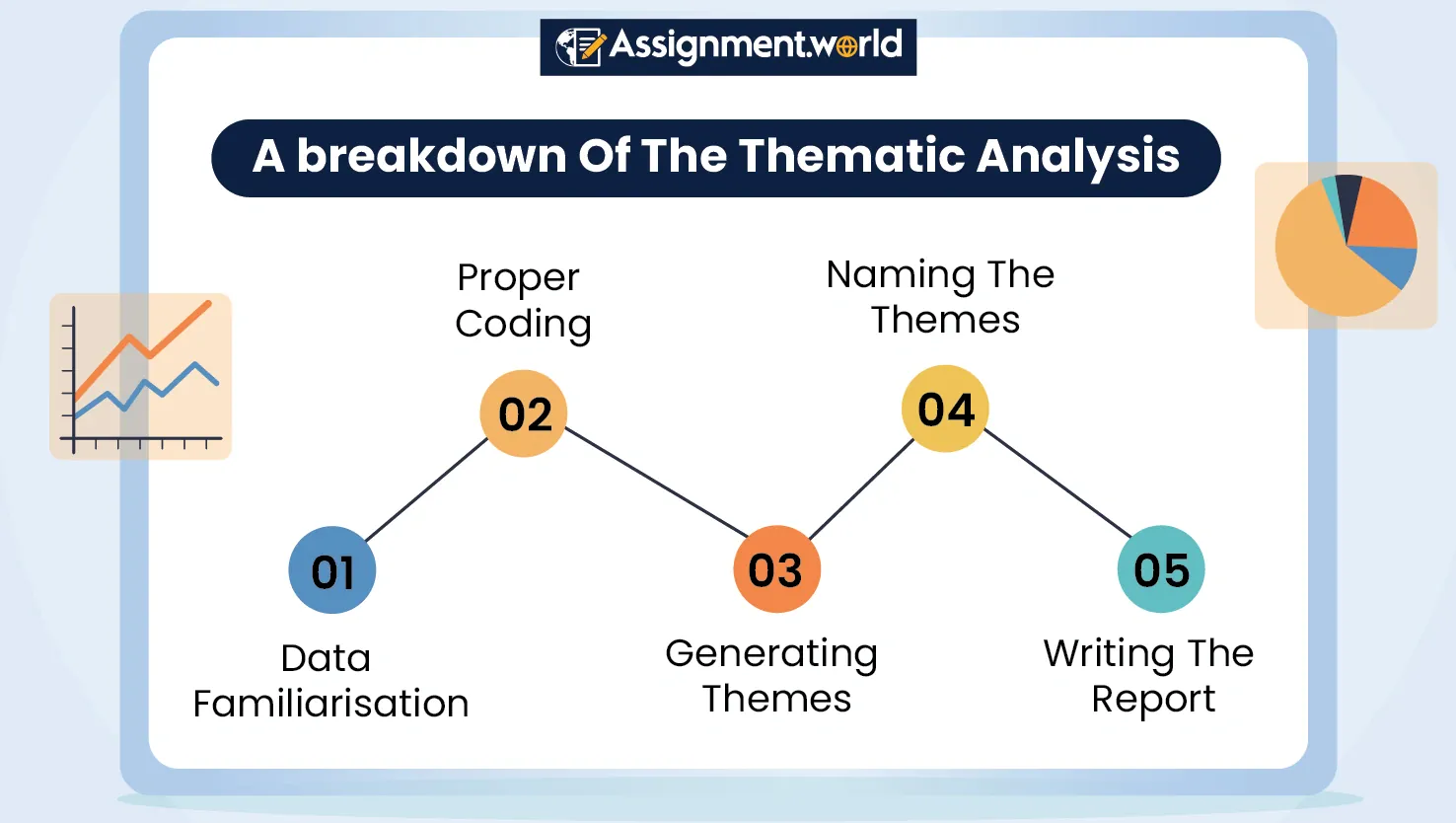
Thematic data analysis has to be performed in a step-by-step manner, maintaining the right order. The most significant systematic approach to conduct such an analysis is illustrated below.
Learn about Data and Identify Themes
The first of the thematic analysis steps is to learn about the data and get familiar with it and its components. It can help you handle any upcoming element regarding your data that you are going to analyse. It will further guide you to get an idea or an overview of the process that you need to consider to develop a proper framework for the analysis.
Decode Underlying Message and Code
The second step of thematic data analysis is decoding the underlying message by simply noticing and highlighting any section that reflects a specific theme and comes up with a definite code.
Thematic Analysis Example
Suppose you have to analyse an interview on a research topic like climate change. Here you have to identify particular phrases and sentences that define codes like factors affecting climate change, personal beliefs, acknowledgement of climate change and so on.
Create New Themes and Review
The above step will help you further generate new themes based on the main details of the dataset. Then you have to review the themes properly to categorise the themes of the data that you are researching. However, always remember to deal with complexity thematic analysis; you can write your research paper with research paper writing services.
Categorising Theme
The fourth step for doing your thematic data analysis is to divide your data into different categories, taking the common properties into consideration. These common properties should always define the main themes of your data.
Compose the Thematic Analysis Narrative
Now it is time to prepare the narratives and write your thematic analysis for the research paper. You need to present your viewpoint regarding the data analysis without any bias. Be sure you develop your claims with appropriate points of argument that support your overall analysis.
Thematic Analysis Example
If you are researching a healthcare industry-related topic, then your narrative should reflect some essential factors like patient experience, the perspectives of healthcare providers, the effectiveness of interventions and others.
Hope you have gained valuable insights into this particular type of data analysis. Remember, you need to understand the key aspects of this data analysis to suit your research needs and elevate your research paper with more accurate and consistent results. This guide from Assignment World is specifically designed for students who struggle to grasp the definition and proper application of thematic data analysis in their research.
So, now you can write your data analysis more prominently, which will also help you get good marks for your research paper undeniably. However, if you have any difficulty in writing it, you can reach out to us on our website, and we will help you write a good thematic analysis in no time.