
235,715
Delivered orders

Searching someone who can help with assignment help online? Hire our best assignment experts and enjoy the best grade.

re you studying abroad and finding it difficult to manage complex assignments, overlapping deadlines and personal
responsibilities? Learning how to Make The Most of Assignment Help Services can help you access academic guidance while continuing to develop your own research and writing skills.
studies and need some help with your assignments? We hear you, and therefore, we offer you this blog that shows why we use Assignment help services and some reasons for using them. The academic world is blooming every day; new technologies and new subjects are being introduced to students all over the world.
The academic world is evolving every day, with new technologies, assessment formats and subject areas being introduced to students worldwide. Used responsibly, academic support can help students understand complex briefs, organise their research and improve clarity without replacing independent learning.
Now, many students understand the purpose of assignment support and follow the online assignments help process to manage academic tasks more efficiently. This blog explains how students can use academic guidance safely, evaluate providers and make informed decisions.
Why do use Assignment Help Services when universities already offer learning resources? Students may seek flexible support, subject-specific explanations, proofreading, referencing guidance or help interpreting an assessment brief. However, they should always check their institution’s academic integrity policy before using an external provider.
International students may also be adjusting to a new education system, unfamiliar marking criteria or a different academic writing style. This makes it important to understand both the benefits and the limits of external support.
When students ask why academic support is useful, several practical considerations arise. Knowing how to use assignments help services can be especially valuable when students need help understanding requirements rather than replacing their own work.
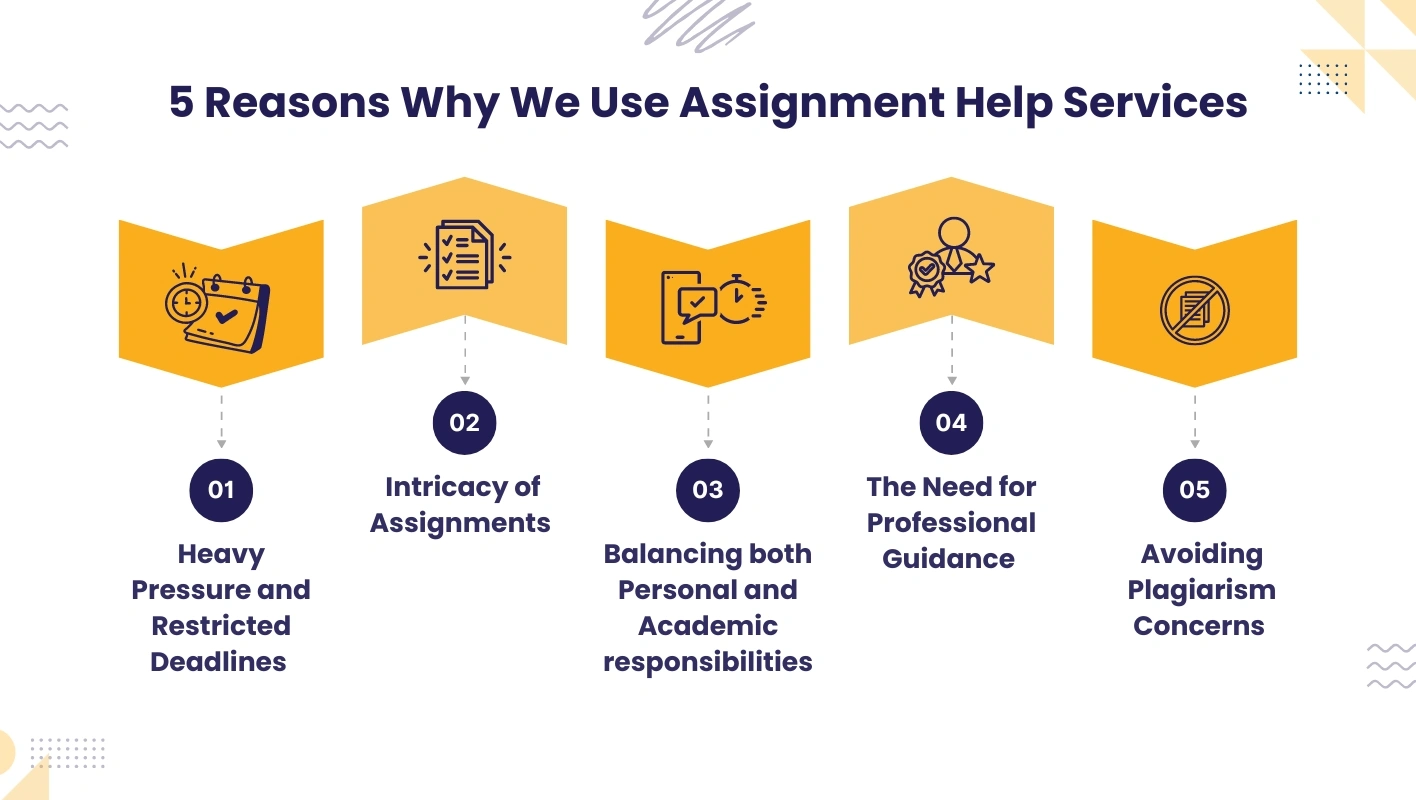
The following 5 reasons why we use assignment help services focus on workload management, subject understanding, professional feedback, referencing and the challenge of balancing study with other responsibilities.
Heavy Pressure and Restricted Deadlines
One of the main reasons students seek assignment guidance is the volume of assessments they may need to complete within a limited period. Several units require essays, reports, presentations and projects at the same time.
Academic guidance may help students divide a large task into manageable stages, identify priority sections and create a realistic study plan. Students should still complete their own learning activities and avoid relying on last-minute assistance.
Intricacy of Assignments
As subjects become more specialised, assessments may require detailed research, critical analysis, calculations, case evaluation or the application of unfamiliar theories. Some students understand the topic but struggle to interpret what the marking rubric expects.
Subject-specific guidance can clarify difficult concepts, assessment criteria and suitable research methods. For example, a student may ask how to structure a literature review or interpret a case study instead of requesting a ready-to-submit paper.
Balancing Personal and Academic Responsibilities
Students often balance coursework, employment, family commitments and personal responsibilities. Managing these demands may leave limited time for planning, research and careful editing.
Appropriate support can help students understand where to begin, organise the task and identify gaps in a draft. Such guidance should complement, rather than replace, independent study.
The Need for Professional Guidance
Students are still developing academic skills, and complex topics can sometimes feel overwhelming. They may benefit from consulting tutors, editors or subject specialists with relevant qualifications and experience.
Professional guidance may include explaining a concept, reviewing an outline, identifying unclear arguments or suggesting ways to improve evidence. A credible provider should be transparent about expert suitability, service limitations and the type of support being offered.
Avoiding Referencing and Originality Concerns
Incorrect citation, weak paraphrasing and incomplete reference lists can create academic-integrity concerns. Students who are unfamiliar with APA, Harvard, MLA, Chicago or other styles may need guidance on how to acknowledge sources correctly.
Reliable support may include citation checks, referencing guidance, editing and originality support with a similarity report where applicable. Students must still verify every source and follow the requirements in their assessment brief.
These 5 reasons why we use assignment help services show that students gain the most value when support is used to clarify expectations, strengthen skills and improve the quality of their own work.

The online assignments help process can be systematic and useful when the provider clearly explains each stage. It usually begins with sharing the assessment brief, identifying the type of guidance required and confirming the service terms. A transparent process may include the following steps:
Share the assessment brief, marking rubric, academic level and deadline.
Explain whether you need proofreading, editing, referencing guidance, an outline or concept clarification.
Confirm the scope, price, delivery schedule and revision conditions.
Check whether the selected specialist has relevant subject knowledge.
Review the academic guidance, edited draft or model reference carefully.
Ask questions about unclear recommendations.
Verify facts, calculations, sources, citations and formatting.
Apply the feedback to your own work.
The online assignments help process should not require access to a university portal, student email account or other unnecessary personal information. A credible provider should also explain how data is stored, protected and deleted.
An effective assignments writing service guide should help students understand what to check before submitting an enquiry or paying for support. It should cover service quality, specialist suitability, privacy, pricing, revisions and responsible use.
Clear instructions help a provider understand the student’s needs and reduce the risk of irrelevant guidance. Before seeking support, share the assessment format, topic, word count, course level, referencing style, deadline and marking criteria.
Remove personal or confidential information that is not required. Providing complete academic instructions also helps the expert write the assignment accurately rather than making assumptions.
Students should ask questions, provide relevant updates and clarify any part of the task that may be misunderstood. Important instructions, agreed deliverables and revision terms should be kept in writing.
Students should also ask about the specialist’s experience in the relevant subject. Transparent information about qualifications and expertise is an important trust signal, although all guidance should still be reviewed independently.
Writing samples can help students assess structure, clarity, referencing and subject knowledge. A useful sample should demonstrate logical organisation, appropriate evidence and consistent academic style.
Samples should be used only to evaluate quality. Students should never copy sample material into an assessment or assume that an attractive sample proves expertise in every subject.
A credible provider should explain its revision policy before payment. Students should check what qualifies as a revision, how long the revision period lasts and whether changes outside the original brief involve additional charges.
Clear revision terms help students understand their options if the guidance does not match the agreed instructions.
A practical assignments writing service guide should also encourage students to read privacy, refund, payment and data-retention policies. Avoid services that hide charges, request university login details or make unrealistic claims about grades.
Contacting a service early allows time to explain the brief, review the guidance and ask follow-up questions. It also reduces the pressure to accept unsuitable support because a deadline is approaching.
Decide whether you need proofreading, editing, referencing guidance, feedback on a draft, an outline or help understanding a concept. Learning how to use assignments help services effectively begins with making a precise request.
Compare every recommendation with lecture materials, the assessment brief and the marking rubric. Make notes about why a suggested change improves clarity, evidence, structure or academic style.
Check that cited sources exist, support the relevant claims and are suitable for your academic level. Review calculations, quotations and technical explanations before relying on them.
Use guidance as a learning aid or model reference. Rewrite ideas based on your own understanding and keep drafts, notes and research records that demonstrate your contribution to the assessment.
These practices support responsible learning while protecting academic integrity and building long-term skills.
Confirm that the provider offers support relevant to your subject, assessment type and course level. A specialist in business management may not be suitable for an advanced engineering calculation or a postgraduate nursing assessment.
The provider should explain how specialists are selected and whether their qualifications or experience are relevant to the requested discipline. Students should remain cautious when expertise claims cannot be checked.
Review available samples, service descriptions and specialist information before committing. Look for clear academic structure, appropriate evidence and consistent referencing instead of relying only on promotional claims.
Read detailed feedback across more than one source where possible. Be cautious when every testimonial uses similar wording, lacks context or makes unrealistic claims. Reviews can provide useful context, but they should not replace an independent assessment of policies, samples and service terms.
Ask whether proofreading, formatting, revisions, similarity reports or urgent delivery involve extra charges. Extremely low prices may not provide enough time for appropriate research, review or specialist input.
A reliable provider should use secure payment methods and provide a clear communication channel. Students should never share passwords, university login details or confidential information unrelated to the service.
These checks explain how to choose the top assignments help service without depending on unsupported promises. Students should compare several providers and select one that offers realistic terms, clear boundaries and learning-focused support.
How assignments help services work depends on the type of assistance requested. Some students may need a concept explained, while others may need proofreading, structural feedback, formatting or referencing guidance. Ethical academic support may include:
Explaining difficult concepts;
Helping students interpret an assessment brief;
Providing feedback on structure and clarity;
Reviewing grammar and academic expression;
Suggesting suitable research directions;
Checking citations and formatting;
Providing model reference material for study.
Understanding how assignments help services work also means recognising their limits. A provider should support the student’s learning rather than impersonate the student, access a university system or encourage academic misconduct.
Frequent reliance on outside support can weaken independent research, writing and problem-solving skills. Students can reduce this risk by setting a learning goal for every interaction and applying the feedback themselves.
Not all providers meet the same standards. Students should review explanations, calculations, quotations and references against credible academic sources and course materials.
Provider feedback should be treated as guidance rather than unquestionable authority. Where information is technical, current or discipline-specific, students should verify it through library databases, prescribed readings or their lecturer.
Incomplete instructions or unclear expectations may lead to irrelevant support. Sharing the complete brief and asking the specialist to confirm the task can reduce this risk.
The reasons discussed above should not be interpreted as an argument for replacing student work. External assistance can raise integrity concerns when its use conflicts with institutional rules.
Students should choose ethical support that promotes learning, avoids misrepresentation and encourages disclosure where required.
Academic support comes at a cost, so students should compare the full price and understand what is included. Before paying, they may also check whether their institution offers free help through a library, learning adviser, writing centre, lecturer or peer-tutoring program.
Before using a provider, ask the following questions:
Does the service provide guidance relevant to my subject?
Are prices, deadlines and revision terms clearly stated?
Can I review appropriate samples?
Does the provider explain its privacy and refund policies?
Are its claims realistic and verifiable?
Can I communicate clearly with the support team or specialist?
Does the service promote responsible academic use?
Will I have enough time to review and learn from the material?
Students searching for assignment services should choose support that helps them understand assessments and strengthen their own work. A suitable service may connect the student with an assignment writer or academic specialist who can provide explanations, editing or model-reference support.
The best assignment help should improve clarity, structure and academic confidence without making unrealistic promises or replacing the student’s responsibility.
Following this checklist is another practical way to Make The Most of Assignment Help Services and evaluate whether a provider demonstrates transparency, relevant expertise and responsible service boundaries.