235,715
Delivered orders

Searching someone who can help with assignment help online? Hire our best assignment experts and enjoy the best grade.
e have all started using ChatGPT in recent times, whether it is for a small Google search or for detailed
rogramming assignments are the tasks and projects which are assigned to the students. These assignments focus on the
W
e have all started using ChatGPT
information. With that, many of you have also used ChatGPT for academic writing. We all know it gives you all the information at your fingertips within just a few minutes. But the question is, is it really ok to use it for your academic papers?
in recent times, whether it is for a small Google search or for detailed information. With that, many of you have also used ChatGPT for academic writing. We all know it gives you all the information at your fingertips within just a few minutes. But the question is, is it really ok to use it for your academic papers?
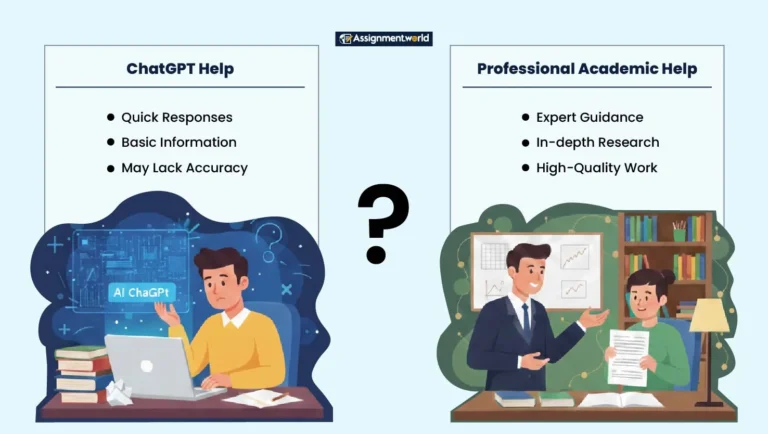
If you need someone to help with your assignments, wouldn't a professional service be a better option for you? And here comes the debate of ChatGPT vs professional academic help. To find out the answer, why don't we look at this blog, which not only gives you an answer but also compares both chat and professional services to tell you what can be the best option for you.

Before we start seeing the difference between ChatGPT and professional writing services, we need to understand what ChatGPT for academic writing actually does. ChatGPT is one of the most popular AI-powered models that is developed to answer human-driven questions. So naturally it is developed to answer any of your questions, even generate essays or reports while mimicking academic tones.
It's free; there's no need to spend any money. However, like any other service, it has limitations. Yes, ChatGPT can write for you, but no matter what, it can not “think” or “research” like humans. If you ever wondered how accurate is ChatGPT for essays? The answer would be complicated.
When you are using it, you get the help of a tool that is trained on data. However, it does not have a human sense of maintaining academic honesty, referencing or original requirements. This difference has a significant impact on your academic papers and the way you academically write.
To be honest, using ChatGPT for academic writing is an easy shortcut. With its help, you can save time. It gives you instant feedback and helps you structure your ideas clearly. A few benefits:
Speed and Accessibility: You can craft essays and drafts within minutes. ChatGPT operates 24/7, and it helps you whenever you want, even when your deadline is close.
Enhanced Structured and Accuracy: If you are not sure how to present your ideas, then ChatGPT will structure them for you. It can generate a well-structured outline academically for you.
Learning Support: ChatGPT just writes for you. It explains the subjects, topics in the easiest way to improve your skills and learning.
Cost-Effective Solution: Well, ChatGPT is free to use, unlike professional writing services that can often be costly, depending on the different services. However, even ChatGPT’s premium version is more affordable for students.
Unique Topics: One great part about using AI for your assignments is that it will give you a bunch of unique ideas across many topics, in a limited time. While that can't be possible in human expertise.
These advantages make the use of ChatGPT fitting for use in academic writing.
As we all know that every action has its opposite reaction. Some limitations of ChatGPT make it less effective than professional academic writing services.
Limited Accuracy and Understanding: You might ask: How accurate is ChatGPT for essays? The truth is, it is not 100% accurate. It can generate content for you; however, it can also write incorrect facts, outdated data and false references. This type of inaccuracy is not acceptable for your academic papers.
Lack of Subject Expertise: Professional academic services always have experts across different subjects, be it management, law or anything specific. ChatGPT only provides generalised knowledge that lacks proper, experienced research.
No Accountability: ChatGPT can craft you any assignment, but it does not guarantee anything. While having professionals means taking responsibility for originality, revision and polishing your assignment.
Plagiarism and AI Risks: The biggest risk of using ChatGPT for academic writing is plagiarism and AI-generated text. That not only destroys your original efforts but violates academic honesty, resulting in consequences like failing grades and even suspension.
Both the Pros and cons of AI academic help influence your decision on using it for your academic assignments.
Take a look at this table for a better understanding of these two’s comparison:
| Criteria | ChatGPT | Professional academic help |
|---|---|---|
| Cost | Free or affordable | Moderate to high |
| Speed | Instant | Depended on the complexity of the assignment |
| Accuracy | May include errors or outdated info | Fact-checked and reviewed information that is relevant to your assignment |
| Originality | Needs manual checking | 100% original, plagiarism-free |
| Expertise | General knowledge | Subject-matter expertise |
| Ethics | Risky if used directly | Ethically sound when used for guidance |
The battle between ChatGPT and professional academic help is not just about writing a paper; it also involves maintaining the aforementioned features.
In summary, we can see that ChatGPT offers a quick boost, but professional help services bring reliability, correctness and academic compliance.
The concept of reliability depends on how you are using it for your assignments. If you are using it as a learning tool to generate ideas and summarise context, and understand specific topics, then yes, it is reliable.
However, if you are using it to generate your whole work, and all you do is merely copy and paste it. Then no, it can never become a reliable option for you. AI tools lack the skills of critical thinking. Moreover, if you replace your work with AI, then you no longer have a role for yourself. You will end up with an essay that sounds well but fulfils its main purpose.
So, when you are thinking, is ChatGPT reliable for academic work? Remember to ask yourself how you are using it for your own work.
| Pros | Cons |
|---|---|
| 1. Save time and brainstorm ideas | 1. Lack of originality and in-depth analysis |
| 2. Offers quick grammar and structure enhancements | 2. Risk of plagiarism and AI-detection |
| 3. Improve understanding of complicated topics | 3. Might interpret the assignment brief |
| 4. Give you immediate answers and feedback | 4. Doesn't follow academic standards and citations properly |
These pros and cons of AI academic help will help you to decide if you want AI’s help in your assignment or not.
In comparison to ChatGPT, professional help is very different. Professional academic writing services have human experts on different subjects to meet the mentioned requirements and standards. They are experts in reaching, critically thinking, correctly referencing and meeting your university guidelines step-by-step.
Such experts do not just write, they describe, revise and proofread. Something that is not ChatGPT's forte. Further, they opt for originality to maintain academic honesty and provisioning revisions if needed.
You do not just get polished work from online assignment help, but understand the process. This is something that ChatGPT can never do. In summary, while ChatGPT can assist you, professionals still empower your growth.
With this blog, you have gotten the answer to Is ChatGPT reliable for academic work? It is clear that AI can not replace professional services; however, you can still use it as a supporting tool for your learning and understanding. While you can reach out for professional services for original work.
Do you know which professional service to ask? Why not try our services? Assignment World has the best assignment help for you. We provide high-quality original work that meets your exact academic standards. So, without any delay, reach us for your assignment.