
235,715
Delivered orders

Searching someone who can help with assignment help online? Hire our best assignment experts and enjoy the best grade.

riting your assignment require presenting evidence from different sources. To maintain academic integrity,
rogramming assignments are the tasks and projects which are assigned to the students. These assignments focus on the
W
riting your assignment
you should credit authors accurately. Using footnotes in assignments is one of the easiest, precise, and widely known methods.
require presenting evidence from different sources. To maintain academic integrity, you should credit authors accurately. Using footnotes in assignments is one of the easiest, precise, and widely known methods.
Do you know how to make a footnote citation? Well, this blog will guide you, as we will tell you everything you need to know. So, you will know its purpose and how you can differentiate footnotes from endnotes. Learn how to use footnotes in APA and MLA style with practical steps.

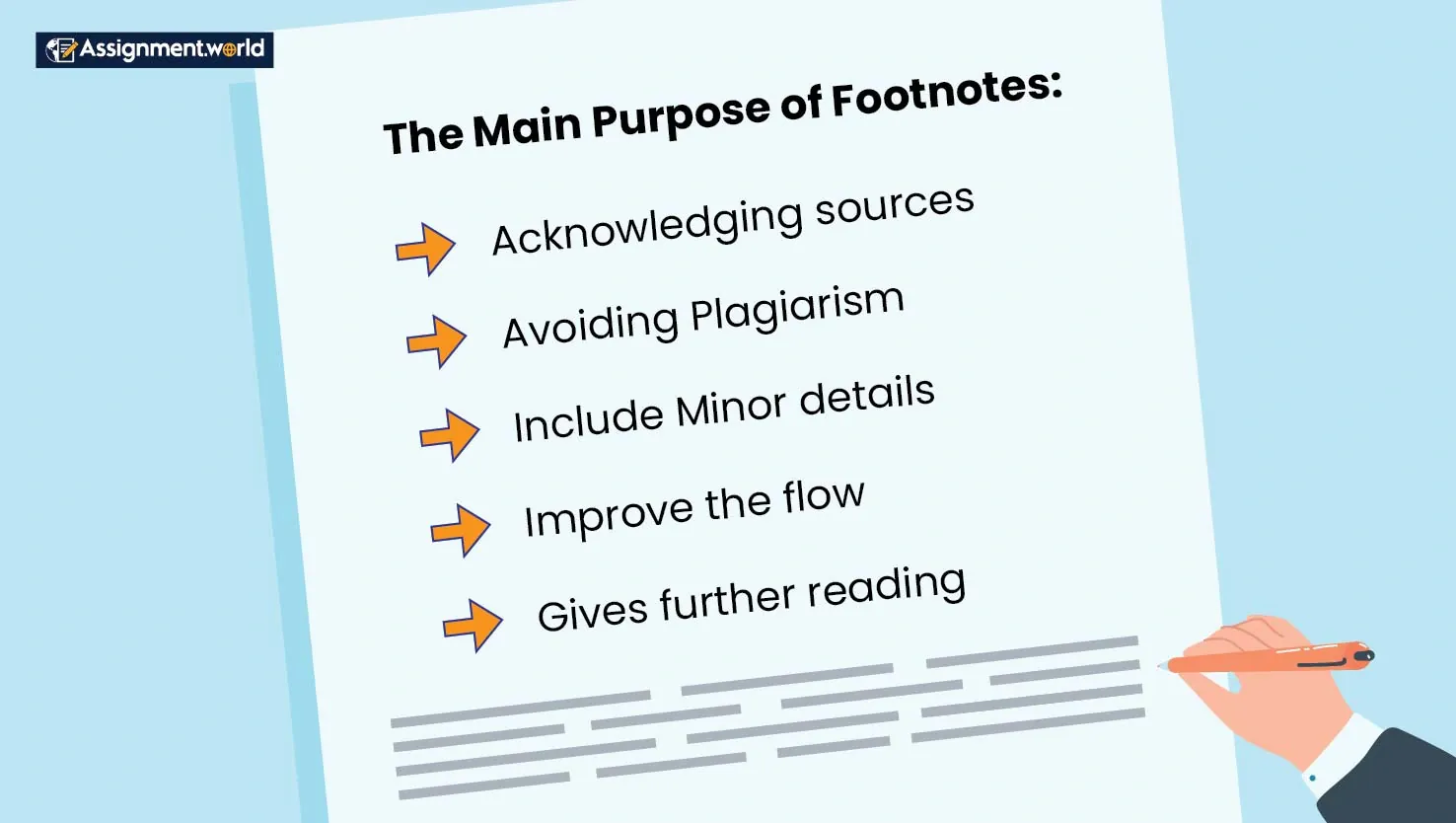
The notes at the bottom of the page that provide additional information or cite sources are called footnotes. They allow your instructor to check the origin of the information without interrupting the reading flow. Universities often suggest using footnotes when there is a need for detailed references, supplementary comments or clarifications that might otherwise disrupt the main discussion.
For example, when referencing a book or article, a superscript number appears at the end of the cited sentence, corresponding to a note at the bottom of the page containing the complete source details.
Purpose of footnotes -
To credit the source of information.
To add supplementary data or explanations.
To guide the audience through further readings and resources.
To improve the credibility of your academic writing.
You might have been confused about footnotes and endnotes, but the distinction is significant yet straightforward -
| Aspect | Footnotes | Endnotes |
|---|---|---|
| Placement | Appears at the bottom of the same page | Listed collectively at the end of the document |
| Readability | Easily accessible while reading | Requires flipping to the end to view details |
| Usage | Common in history, law and humanities papers | Preferred in lengthy reports and research papers |
| Purpose | Offers immediate reference or explanation | Used for grouped references and extended notes |
This apparent difference between footnotes and endnotes explains that footnotes are ideal for finding the citation details quickly. On the other hand, endnotes are more suitable for longer papers where numerous references might clutter pages.
Consistency and clarity are a must while creating a footnote. The general process involves inserting a superscript number in the main text and providing the corresponding note at the bottom. Follow these steps -
Step 1: Insert the Superscript Number
Place a superscript number directly after the sentence or quotation that requires citation. Avoid placing it before the punctuation marks.
Example: Scholars argue that leadership is about both innate and learned.
Step 2: Add the Corresponding Footnote
At the bottom of the same page, add the complete reference for the superscript number. Include the author's name, publication title, date, and page number (if applicable).
Example: 1. Riggio, R.E. and Newstead, T., 2023. Crisis leadership. Annual Review of Organisational Psychology and Behaviour, 10(1), pp.201-224.
Step 3: Maintain a Consistent Formatting
All the footnotes should follow a consistent format based on the required citation style, like APA and MLA. Use a smaller font size, like 10 or 11pt and single line spacing.
By following these three simple steps, you get the answer to your question on how to write footnotes in an assignment.
Citing sources correctly is critical for maintaining academic integrity. Each citation style has distinct rules for how to make a footnote citation. Below are examples of how to cite sources in footnotes-
Books - 1. Author's First Name, Last Name, [Book Title] (place: Publisher, Year), Page Number.
Journals and Articles - 2. Author's First Name, Last Name, [Article Title], (Journal Name), Volume, no. Issue (Year): Page Number.
Website - 3. Author or Organisation, [Page Title], (Website Name), Publication Date, URL.
Ensure that every source listed in the footnote is similarly included in your reference list and bibliography (If applicable).
The APA format primarily focuses on parenthetical in-text citations; however, it can still be used to give extra details or clarifications. When using footnotes in APA
Use superscript numbers after punctuation.
Number notes consecutively throughout the text.
Keep notes concise; they should not repeat citation information already included in the reference list.
Example: Marketing trends are constantly changing in response to digital innovation.
Additional data were collected from the survey conducted among 250 marketing professionals in 2024.
APA footnotes are invaluable for explaining abbreviations, adding contextual notes, or referencing unpublished materials.
In the MLA format, footnotes are either bibliography references or additional comments. While MLA is about using in-text citations, some instructors allow or prefer footnotes for clarity in complex words. How to write footnotes in MLA? -
Place notes at the bottom of the page.
Use Arabic numerals.
Maintain double spacing in both the main text and footnotes.
Keep the first line of each footnote flush left, indent subsequent lines.
Example: Modernist writers have changed how stories are told.
Nico Robin, Modern Literature Studies (New York: HarperCollins, 2021), 82.
MLA footnotes should not duplicate entries in the "Works Cited" section but provide extra clarification or attribution when needed.
Here are some key formatting rules to make sure that the footnotes look professional and accurate -
Font - Use Times New Roman, Arial or specifically mentioned font style (If provided), size 10 or 11 pt.
Spacing - Single spacing within a note, double spacing between notes
Indentation - The first line starts flush left, subsequent lines are indented.
Numbering - Begin with "I" and continue sequentially throughout your paper.
Punctuation - Place the superscript number after punctuation marks (Period, commas).
Consistency in footnote formatting will ensure that your academic paper maintains a clear, scholarly appearance that will help your readers navigate the sources effortlessly.
Using footnotes in assignments improves your academic paper's credibility and scholarly value. Here is why they matter -
Transparency - Instructors can trace your research process.
Professionalism - Reflects attention to academic standards.
Clarity - Keeps the main text clean while providing detailed references.
Academic integrity - Prevent plagiarism by properly acknowledging sources.
Even a well-researched paper can lose its credibility with minor mistakes. Here are the errors that you need to avoid -
Avoid inconsistent numbering; you need to maintain the numerical order.
Incomplete details are a no, so make sure your citations have the author name, title, publication, date, and page number.
Do not mix the citation styles; stick to only one style for the assignment.
Do not overuse footers; use them only when necessary.
Stop repeating references. Instead, use shorter versions of previous citations when the same source is cited multiple times.
Avoiding these mistakes will help you make your paper professional and easy to follow.
Footnotes in assignments are more than just a formatting requirement; they are an essential academic tool that will support your transparency and credibility. When you understand the correct style, structure and format, you can enhance the quality of your academic paper.
Want to know more about footnotes? Our services will help you with that. Assignment World provides the best assignment help to you; with this, you will master using footnotes in academic papers. So next time you are asked to use footnotes in assignments, follow this blog for the best results.