
235,715
Delivered orders

Searching someone who can help with assignment help online? Hire our best assignment experts and enjoy the best grade.
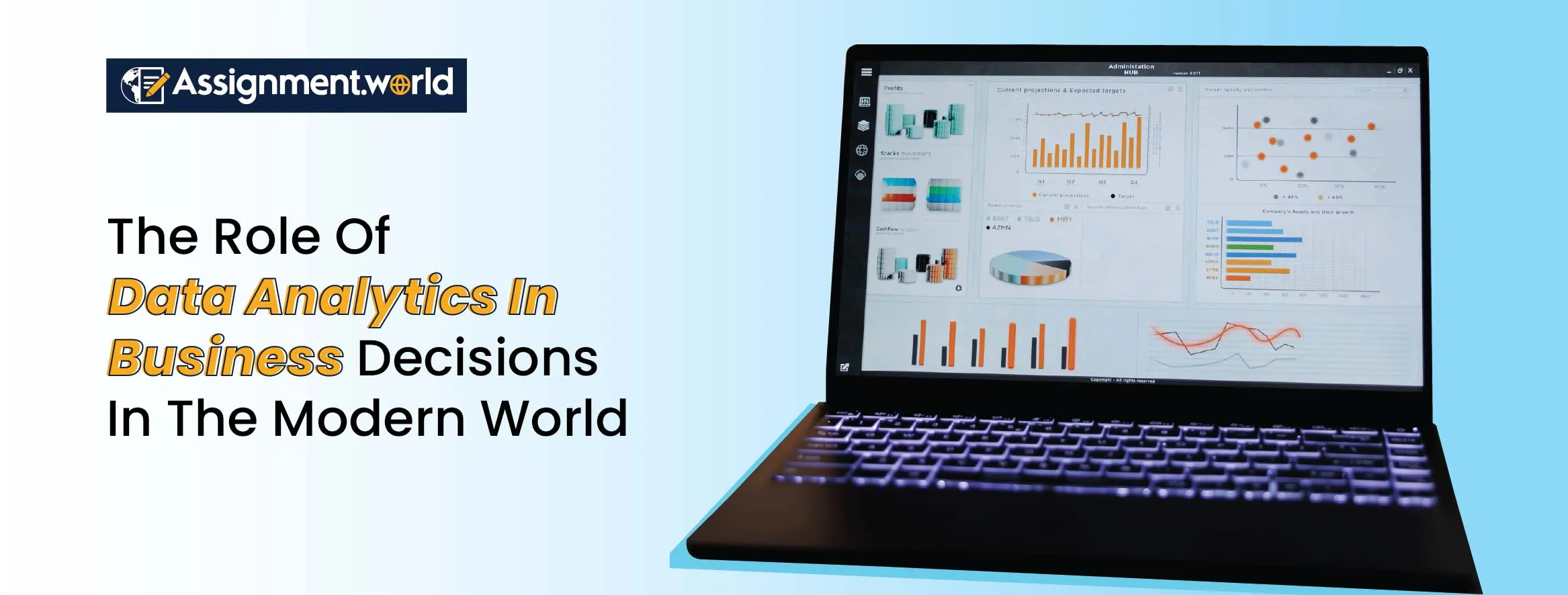
n the current fast-moving business environment, decisions can no longer rely on instinct alone. Now companies are
rogramming assignments are the tasks and projects which are assigned to the students. These assignments focus on the
I
n the current fast-moving business
increasingly dependent on data to reduce uncertainty, uneasy patterns, and make strategic choices. The role of data analytics in business decisions has expanded greatly, helping many companies to move from reactive thinking to proactive and predictive planning. For you to understand this shift is necessary, as analytics continue to shape how businesses compete and grow.
environment, decisions can no longer rely on instinct alone. Now companies are increasingly dependent on data to reduce uncertainty, uneasy patterns, and make strategic choices. The role of data analytics in business decisions has expanded greatly, helping many companies to move from reactive thinking to proactive and predictive planning. For you to understand this shift is necessary, as analytics continue to shape how businesses compete and grow.
If you are on a mission to discover how data analytics support better decision-making across different business functions, then you are at the right place. Together, let's know how data analytics transforms strategic decisions and identify trends. By the end of the day, you can understand how data transfer decisions are made and why analytical skills are becoming increasingly critical in the modern business environment.

Data analysis in business decisions holds the ability to convert raw data into actionable insights. Businesses contain massive volumes of data daily, from consumer interactions to operational processes. The role of data analytics in business decisions is to help make sense of this data by identifying the trends, risks, and opportunities that might otherwise remain hidden.
Which means your decision presents evidence rather than being associated with recently supported decisions. Whether your company is selecting a market entry strategy, optimising the supply chain, or enhancing consumer experience, data analytics ensure that decisions are based on actual facts. This action can reduce uncertainty and enhance the likelihood of successful outcomes.
More notably, analytics support consistency in decision-making. When you are using standardised data and analytical models, decisions across departments align with overall business goals. This unified approach enhances efficiency and long-term planning.
One of the most powerful moves of data analytics is how it converts strategic decisions. Strategic decisions often involve highly rated long-term results and important investments. Analytics allows businesses to simulate scenarios, forecast any outcomes, and evaluate the risk before committing resources.
For you, data analytics transforms strategic decisions, which means strategies are no longer static. Companies continuously study performance data and adjust strategies in real life. For example, market trends pinpointed through analytics can influence pricing strategies, product launches or expansion plans.
Analytics also fosters competitive advantage for your company. When you analyse competitive data and market behaviour, your business can identify gaps and opportunities. Strategic decisions became forward-looking rather than reactive, allowing your company to stay ahead in the current dynamic market.
Descriptive style analytics focus on understanding what has already happened by examining the historical data. It summarises a large database into meaningful reports, dashboards, and visualisations. Your company may use this approach to track performance indicators such as sales trends, consumer behaviour, and operational and efficiency metrics.
For you, descriptive analytics provide a foundation for comprehending business performance. It answers questions like:
What are the sales figures for this month?
Which product performs the best?
Which regions underperformed in this period?
These key insights help your company to identify the strengths and weaknesses. Although descriptive analytics does not predict future outcomes, it still plays a crucial role in accountability and performance evaluation. Hence, without understanding the past results, your company cannot effectively plan for the future to enhance the decision-making process.
While the descriptive type of analytics looks backwards, on the other hand, prescriptive analytics focus on suggested optimal actions for the future. This is a combination of advanced techniques, such as machine learning, simulations, and optimisation models, to suggest the best course of action.
For many of you, it means that your company is no longer just predicting outcomes; it actively shapes them. With prescriptive analytics, you can recommend inventory levels, pricing strategies or marketing actions based on real-time data. This action minimises the risk and maximises efficiency.
Predictive and prescriptive approaches together strengthen your decision-making. Predictive models forecast what is likely to happen, while prescriptive models suggest how to respond. This integrated approach allows a company to make a confident data-backed decision in a complicated environment.
From marketing, finance, and human resources to supply chain management, analytics informs decisions at every level. Hence, data-driven decision-making has become central to modern business operations.
This means that many of you can affect both strategic and optional choices through data. The marketing team analyses consumer data to personalise campaigns, while the finance team can use it to manage risk and forecast revenue. Operations teams rely on data to enhance efficiency and reduce costs.
Data-driven decision-making also enhances accountability; decisions backed by data are more straightforward to justify and consider. When outcomes are short, analytics helps identify what went wrong and how to enhance future decisions.
In the current time, tools are becoming more user-friendly, allowing non-technical users to interact with data through dashboards and a visual analytics platform. These emerging business intelligence trends are for the enhancement of how analytics support decision-making.
The democratisation of data means decision-making power is no longer limited to analysts or executives. Different teams across a company can now access insights in real time, making faster and more informed decisions.
As another business intelligence trend, the integration of artificial intelligence and automation is reviving insight generation. Your company can now process the vast level of data quickly, identify patterns instantly and respond to change with agility.
Your data analysis assignment demands a combination of hard and soft skills. Where you can apply all these data visualisation, machine learning, and interpretation skills, along with that, you have to show communication, presentation, and critical thinking as well. If all of these are too much for you to handle alone, then grab our data analysis assignment help.
Our professionals at Assignment World are experts in data analysis and critical thinking with a qualified background. They provide attention to every single small detail to make your assignment perfect. With our assignment help online services, you can secure the highest score in your assessments while making sure that your data analysis research paper is meeting all the academic standards as well.
The role of data analytics in business decisions is transforming how companies think, plan, and operate. From understanding past performance to shaping future strategies, analytics allow smarter and more confident decision-making. For you, mastering an analytical concept enhances both academic performance and career readiness.
Business analysis is not an easy task that you can do alone. So if you want some extra help, Assignment World can lend you a hand. Our business analytics assignment help is available for you 24/7; all you have to do is contact us.