

235,715
Delivered orders

Searching someone who can help with assignment help online? Hire our best assignment experts and enjoy the best grade.
s an accounting student, your curriculum may include double-entry bookkeeping, bank statement reconciliation,
rogramming assignments are the tasks and projects which are assigned to the students. These assignments focus on the
A
s an accounting student, your curriculum
and profit and loss account preparation. The field of forensic accounting exists as an independent, specialised discipline beyond basic educational accounting knowledge.Standard number computation is only one aspect of the practice. The real focus is investigation, evidence review, and financial truth.
may include double-entry bookkeeping, bank statement reconciliation, and profit and loss account preparation. The field of forensic accounting exists as an independent, specialised discipline beyond basic educational accounting knowledge.Standard number computation is only one aspect of the practice. The real focus is investigation, evidence review, and financial truth.
To work as a forensic accountant, you must unite your accounting skills with analytical thinking. This profession demands analytical expertise, spreadsheet analysis and financial report evaluation to detect problematic transactions hidden income, and suspicious activity using tax reporting information. A strong understanding of federal taxation helps students see how financial records, tax returns, and business reports connect during forensic analysis.
Your discovery of your potential to solve corporate fraud, provide legal trial assistance, and investigate white-collar crimes can make this subject exciting during your student years.
Federal taxation stands as a key element of forensic analysis practice. Tax records can become strong evidence for detecting fraud, misappropriation, false reporting, and unexplained financial behaviour. The blog provides a clear entry point into an accounting investigative sphere that heavily relies on federal taxation principles. Keep reading to understand the role of taxation in forensic accounting, the techniques used by forensic accountants, and how tax evasion and Tax Planning are reviewed in financial investigations.

Most critical financial probes depend on tracking financial documents through trails found within federal taxation records. Why? Tax records create a dependable financial understanding since all businesses must file them according to mandatory regulations.
Forensic education reveals the importance of tax records. It enables verification of stated income, disclosure of concealed assets, detection of abnormal deductions, and assessment of financial life patterns.
In forensic accounting, tax records can help investigators:
Verify reported income
Identify hidden assets
Detect unusual deductions
Trace unexplained transactions
Compare declared income with lifestyle patterns
Review business expenses
Check whether Tax Planning has crossed into deception
Support forensic analysis during legal disputes
For Example
The business owner uses expensive lifestyle goods despite the company showcasing years of running deficits.
A person repeatedly claims significant charitable gifts without any proof.
A corporation hides its overall income by letting shell companies handle the payments.
A taxpayer may understate cash earnings to reduce taxable income.
Each case becomes clearer to investigators by identifying discrepancies between federal taxation records and other financial documentation. Without accurate tax documentation, validating or disproving financial claims in forensic accounting can become much more difficult.
While studying forensics, you must understand how to detect financial deceptions such as numerical misrepresentations, hidden income, false expenses, or misleading financial reports.
People and companies reveal their financial information through specific tax documents, which provide a deep financial picture. When intentionally misused or distorted, financial documents become instruments for fraud.
Some Common Red Flags
Business owners who overstate their deductible expenses claim more than their company spent.
The practice of hiding revenue is most common among companies that deal solely with cash payments.
Fictitious employees and bogus vendors serve as money transfer methods during the financial reporting of inflated payroll and vendor fees.
Unusual charitable deductions
Mismatch between declared income and personal spending
Shell-company transactions
Repeated business losses without supporting evidence
Here is Another Example
A person may create a significant business loss statement to prevent tax liabilities while lacking essential transaction documentation. A detailed forensic analysis can reveal discrepancies between tax files, invoices, bank deposits, and real-world business activity. The analysis between tax files and real-world data will reveal points that do not match. Your role as a forensic accountant becomes paramount because you must interpret the concealed information within the numbers.
This is where the role of forensic accountant in taxation becomes important. The forensic accountant interprets concealed information within numbers, checks whether tax claims are supported, and explains the findings in a way that may be useful for legal, business, or regulatory review.
Tax planning remains lawful because it allows one to organise one's finances effectively to minimise tax obligations. However, tax evasion is punishable criminal behaviour, and it is one of the main investigative scenarios in which forensic accountants perform casework.
Intentionally representing wrong information becomes a criminal offence that permits people to pay fewer taxes. This can include:
Hiding income from offshore accounts
Falsifying expenses
Failing to report cash earnings
Manipulating company books
Creating fake invoices
Underreporting business revenue
Using shell companies to hide payments
Claiming deductions without evidence
These intentional misreporting activities can result in criminal penalties and possible jail sentences. Forensic accountants are the foundation of trust for government and legal institutions. They evaluate financial records and tax details to identify and establish proof of tax evasion.
Students understand this is crucial, as the role you will take later could involve working on court case reports or acting as a qualified expert witness.
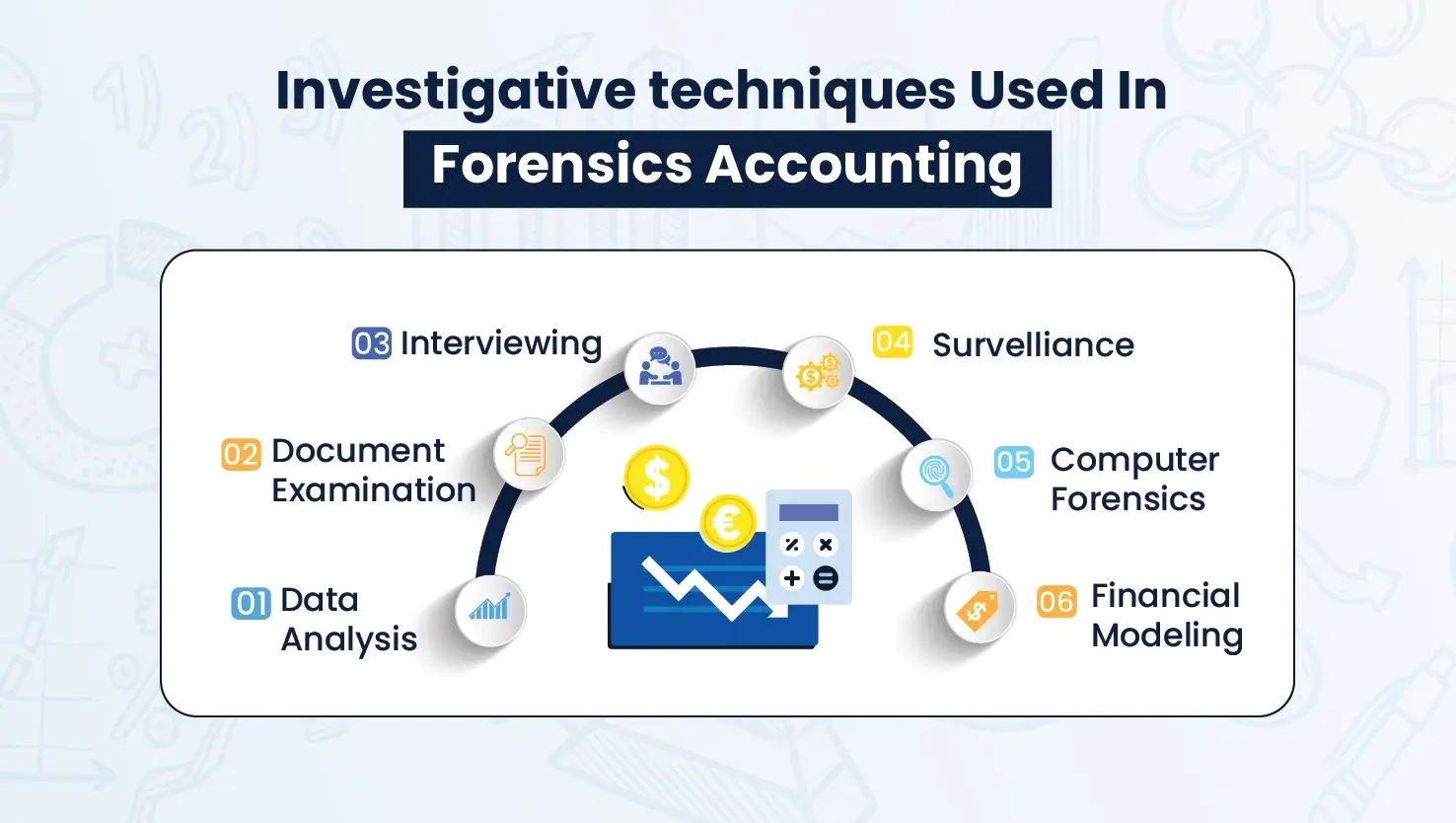
Given below are the essential forensic accounting techniques used by investigators:
Vertical and Horizontal analysis allow students to analyse component performance and conduct financial periodic comparisons. These techniques help forensic accountants identify unusual changes in revenue, expenses, assets, liabilities, or deductions. For example, if marketing expenses suddenly increase without business growth, it may require further investigation.
Benford's Law Analysis is an advanced technical method for detecting fabrications in numerical data. When data is altered, the occurrence of natural numbers in their proper frequency patterns is disrupted. This method can help detect possible fabricated sales figures, expense claims, invoices, or tax-related entries.
Lifestyle evaluation systems use declared financial reports to examine consistent real-life living standards. For example, if someone reports a modest income but owns luxury vehicles, expensive property, or makes large cash purchases, forensic accountants may investigate the source of funds. This method is useful in cases involving tax evasion, hidden income, asset concealment, and unexplained wealth.
Bank deposit analysis compares bank deposits with reported income. If deposits are much higher than declared income, investigators may look for unreported cash sales, undisclosed business revenue, or hidden income streams.
Ratio and trend analysis reviews financial relationships such as gross profit margin, expense ratios, debt ratios, liquidity ratios, and changes across reporting periods. Unusual ratios or sudden shifts can indicate false reporting, inflated expenses, or concealed income.
Modern computer software enables detailed investigations within massive financial databases to spot irregularities. Digital forensic analysis helps detect irregularities that may not be visible through manual review. It can involve examining accounting systems, spreadsheets, emails, transaction logs, and digital audit trails.
Detailed federal taxation records enhance the effectiveness of all investigators' forensic methods. Forensic analysis with these methods leads your investigation from speculation toward proven evidence. Detailed federal taxation records enhance the effectiveness of these Forensic Accounting Techniques because tax files provide a documented basis for comparing income, expenses, assets, deductions, and business activity.
Detailed federal taxation records enhance the effectiveness of all investigators' forensic methods. Forensic analysis with these methods leads your investigation from speculation toward proven evidence.
Legal tax planning is a fundamental business technique, even though tax evasion is illegal. The forensic examination requires you to establish which tax-planning activities cross the acceptable boundaries into deceptive strategies.
A company applies for tax benefits through legal operations such as deductions, tax credits, and offshore subsidiaries. The illegal utilisation of these strategies to disguise income and assets represents fraudulent activities.
For example, a company may lawfully claim deductions, tax credits, or use offshore subsidiaries. However, if those structures are used to hide income, disguise assets, or create artificial losses, the activity may become fraudulent.
Duties Of A Forensic Accountant
Responsible for evaluating the motives and implementing tax strategies.
Assess whether the selected tax planning techniques abide by legal standards.
Flag any tax avoidance scheme having no legitimate economic foundation.
A forensic accountant may also
Check whether deductions and credits have proper evidence
Assess whether business structures have genuine economic purpose
Identify artificial transactions
Review offshore payments and related-party transactions
Determine whether Tax Planning has become tax evasion
Understanding these duties helps you to analyse strategies and preserve financial integrity.
Federal taxation can uncover Financial Deceptions because tax records must usually be supported by documents such as invoices, receipts, payroll records, bank statements, and business ledgers.
In fraud investigations, forensic accountants often compare:
Tax returns with bank deposits
Reported revenue with sales invoices
Payroll expenses with employee records
Charitable deductions with donation receipts
Business expenses with supplier invoices
Asset declarations with ownership records
Company filings with tax submissions
If the numbers do not match, the inconsistency may indicate a mistake, weak documentation, aggressive Tax Planning, or deliberate tax evasion.
For example, a business may report low taxable income while showing high sales deposits in its bank account. This mismatch may suggest unreported revenue, false expense claims, or accounting manipulation.
The role of forensic accountant in taxation is to examine whether tax records fairly represent the financial reality of an individual or business. This requires technical accounting knowledge, legal awareness, analytical thinking, and strong communication skills.
A forensic accountant may be responsible for:
Reviewing income tax returns
Tracing suspicious transactions
Identifying hidden income
Reviewing tax planning structures
Detecting tax evasion indicators
Preparing expert reports
Supporting lawyers during litigation
Explaining findings in simple language
Providing evidence for court or regulatory review
This role is important because tax records can reveal patterns that ordinary financial statements may hide. In forensic accounting, taxation is not only a compliance area; it is also an investigative tool.
Students studying forensic accounting should understand tax records, fraud indicators, and investigative methods because these areas are widely used in real financial crime cases.
Learning forensic accounting techniques can help students:
Analyse financial statements more critically
Understand how fraud is detected
Recognise suspicious tax claims
Distinguish Tax Planning from tax evasion
Interpret financial evidence
Prepare stronger academic assignments
Understand the link between accounting and law
Develop investigative thinking
These skills are useful for students who want careers in auditing, taxation, litigation support, fraud examination, compliance, risk management, or forensic investigation.
Forensic studies stand as a complicated field involving many intricacies. While studying, you face difficulties with forensic analysis, tax code interpretations, and financial crime case studies. The solution to all your academic problems is Assignment World. You can enjoy multiple benefits by reaching out to our accounting assignment help experts for help.
Our experts can handle complex topics like tax evasion, litigation support, or digital audits.
You get academic guidance that can support structure, referencing, formatting, proofreading, and concept clarity.
Our service offers budget-friendly pricing, keeping in mind the budget constraints of the students.
Students who need broader support may also explore online assignment help and assignment expert help for academic writing, research planning, and assignment review. For accounting-specific topics, Accounting Assignment Help can be useful when assignments involve taxation, fraud, financial statements, or forensic investigation.
Forensic accounting necessitates you to remember that your career will extend beyond numerical work. It will be about the truth. The combination of federal taxation theory and forensic tools allows you to discover concealed information and catch financial misrepresentations that restore honest operations to financial environments.
Forensic accounting reminds students that accounting is not only about numbers. It is also about evidence, truth, and accountability. The combination of federal taxation principles and investigative tools allows forensic accountants to uncover concealed income, identify tax evasion, detect Financial Deceptions, and restore confidence in financial reporting.
Your study of tax returns and spreadsheet analysis should involve a more detailed examination of the data. Every set of numerical records conceals untold stories your skills could decipher, and you will likely lead their discovery.
If you get stuck while completing your forensic assignment, contact Assignment World and avail of our expert assignment help.
If you get stuck while completing your forensic assignment, contact Assignment World for academic guidance, assignment review, and accounting support.