
235,715
Delivered orders

A good business plan writing is very important whenever someone is trying to enter or expand a business, irrespective of whether one is based in Australia or the United Kingdom.

business plan is a structured document explaining how an organisation will operate, compete, grow and achieve
its objectives. For international students studying business or marketing in Australia, learning how to write a business plan can strengthen research and professional communication. This writing a business plan guide explains the required sections, practical planning process and academic considerations in clear language.
document explaining how an organisation will operate, compete, grow and achieve its objectives. For international students studying business or marketing in Australia, learning how to write a business plan can strengthen research and professional communication. This writing a business plan guide explains the required sections, practical planning process and academic considerations in clear language.
You will also learn the advantages of writing a business plan and examine a realistic example. Always adapt the advice to your assessment brief, marking rubric and institution’s academic-integrity requirements.

Writing a business plan turns an initial idea into a testable proposal. Instead of relying on assumptions, students must investigate customer needs, market conditions, competitors, costs, risks and realistic growth opportunities.
The main advantages of writing a business plan include:
Clarity and focus: Define the purpose, target audience and measurable objectives.
Better decisions: Compare evidence before choosing marketing, operational or financial strategies.
Risk awareness: Identify possible market, supply, staffing, legal and financial problems.
Financial discipline: Estimate start-up costs, revenue, expenses, cash flow and funding needs.
For an Australian assignment, use relevant local sources and consider customers, competition and regulations. Avoid unsupported claims about demand or profitability.
A standard business plan format commonly includes:
Executive summary
Business description
Market and competitor analysis
Marketing and sales strategy
Organisational structure
Products or services
Operations plan
Risk assessment
Financial projections
Implementation schedule
References and appendices
The final structure depends on the task and marking rubric.
The following business plan step by step process helps students move from an assessment question to a coherent final document.
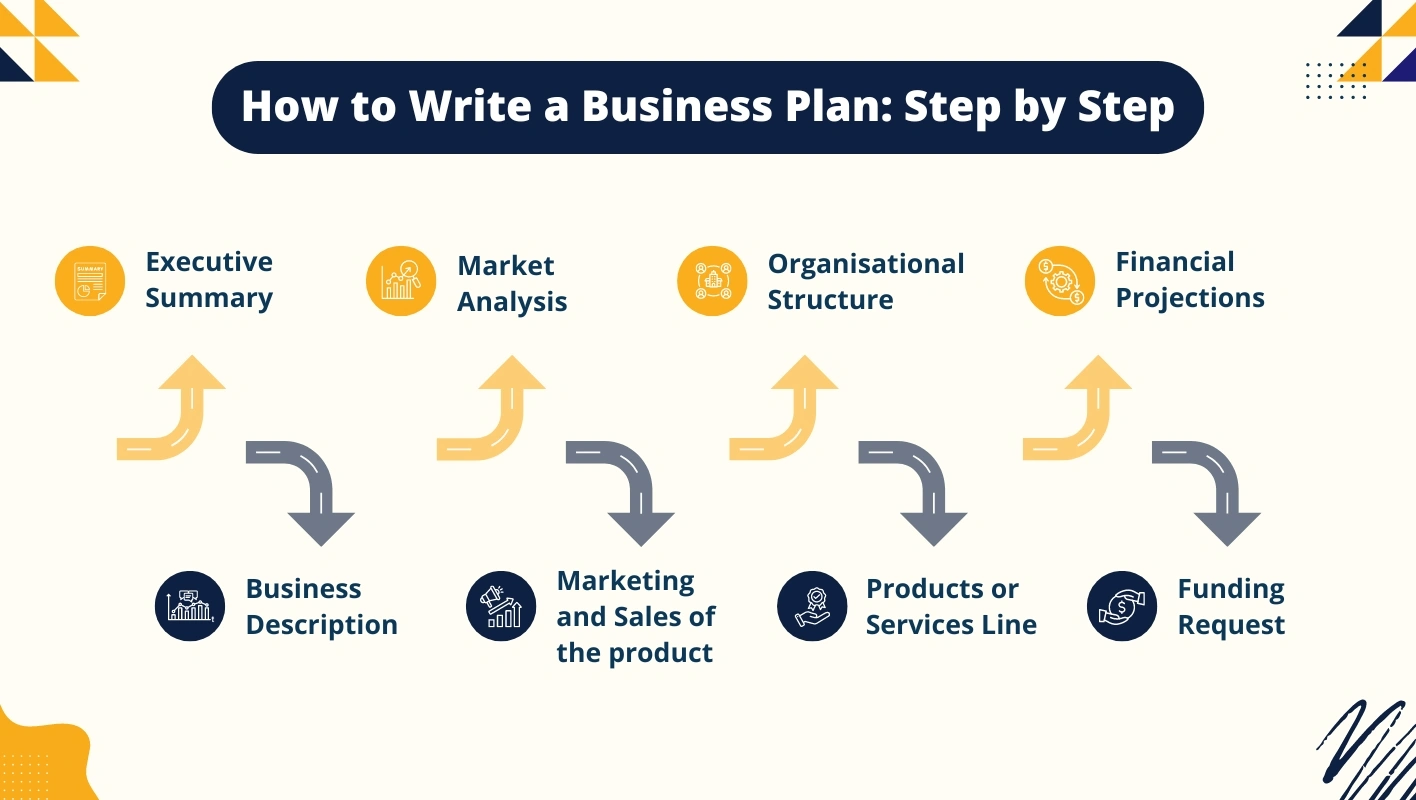
Before researching, identify the assessment question, intended reader, required word count, referencing style and marking criteria. Determine whether the task concerns a new venture, an existing organisation or a case study. This prevents irrelevant discussion and keeps every section aligned with the same objective.
Explain the business idea, industry, operating location and customer problem. Include the mission, objectives, target market and proposed structure, such as a sole trader, partnership or company. Students learning how to create a business plan should support important claims with credible evidence rather than personal opinion.
Analyse market size, trends, customer characteristics and buying behaviour. Identify direct and indirect competitors, then compare their pricing, positioning, strengths and weaknesses. Frameworks such as SWOT, PESTLE or Porter’s Five Forces may help when they contribute meaningful analysis.
This section describes how you will target, acquire and retain customers. Explain your pricing strategy, how you plan to sell your products and your promotional activities.
Address product positioning, pricing, distribution, promotion, sales processes and performance measures. Do not simply list social media, email or content marketing. Explain why each channel suits the Australian target audience and how results will be measured.
Describe key roles, responsibilities, staffing needs, suppliers, technology, premises and service-delivery processes. Include an organisational chart where appropriate. For a sole-owner venture, explain outsourced functions and future staffing needs.
Explain the main features, customer benefits and unique value proposition. Connect each feature to a specific customer need. Also discuss suppliers, quality controls and future improvements where relevant.
Identify operational, financial, market, legal and reputational risks. Explain realistic mitigation measures instead of merely listing threats. Add an implementation table showing tasks, responsibilities and target dates.
Include start-up costs, sales forecasts, profit-and-loss estimates, cash-flow projections, break-even analysis and funding requirements when requested. State the assumptions behind important figures. Never invent numbers to make the proposal appear more successful.
The executive summary provides a brief overview of your business plan. It should include your business concept, goals, target consumer demographic and financial objectives.
Although it appears first, the executive summary is usually easier to prepare after the main sections. Summarise the customer problem, competitive advantage, strategy and important financial assumptions. Keep it concise and avoid adding information not discussed elsewhere.
Compare the draft with the rubric and verify calculations and references. Use consistent business plan format , clear headings, readable tables and professional formatting. Proofread for grammar, repetition and unsupported statements.
Problem: Time-poor students may struggle to access affordable, nutritious meals.
Solution: Pre-ordered meal bundles are available from convenient collection points.
Target market: Students living or studying near selected campuses.
Value proposition: Convenient weekly options with transparent pricing and dietary choices.
Marketing: Campus partnerships, student societies, referral offers and social media.
Marketing: Campus partnerships, student societies, referral offers and social media.
Operations: Meals are prepared by an appropriately approved commercial kitchen and distributed through scheduled collection points.
Operations: Meals are prepared by an appropriately approved commercial kitchen and distributed through scheduled collection points.
Revenue model: Weekly subscriptions and individual purchases.
Risks: Food-safety obligations, changing ingredient costs, demand variability and collection delays.
Financial evidence: Customer estimates, average order value, fixed costs, variable costs and break-even volume.
Interpreting the assessment brief and rubric
Planning headings and section order
Explaining relevant business frameworks
Suggesting research directions
Reviewing market-analysis logic
Checking financial assumptions
Editing Australian English
Improving referencing, formatting and presentation
Providing a model reference or sample structure
Many students struggle to create a business plan properly, so getting help from an expert may make unfamiliar requirements clearer and help identify gaps between sections. It can also support clearer language and more consistent analysis.
The advantages of writing a business plan are greatest when students remain involved in the research and decision-making process. Assistance should improve clarity, structure and academic confidence, not promise a particular mark.
Assignment World offers strategic business plan assignment help for students who need support with planning, research direction, editing, proofreading, referencing or formatting. Students completing postgraduate subjects may also use MBA assignment help to understand strategic frameworks, financial interpretation and professional presentation.
A responsible support process may include:
Reviewing the brief
Confirming the topic and scope
Planning the structure
Identifying suitable research areas
Providing draft feedback
Completing a final quality review
Any model material should be used according to the student’s institutional policies.
Learning how to write a business plan connects academic theory with practical decision-making. A strong proposal explains the opportunity, uses credible evidence, considers risks and presents realistic financial assumptions.
Following a clear writing a business plan guide can make the assessment more manageable. Use the business plan step by step framework as a starting point, then adapt the content to your rubric, subject and Australian context.